Elon Musk Flying Car 2026: What Tesla Actually Revealed
| Quick answer: Tesla unveiled its redesigned, two-seat Roadster at a SpaceX facility in Texas on October 15, 2026. A prototype used thrusters to make short airborne maneuvers and a suction system to travel upside down on a ramp. Tesla is targeting production in 2028, but the final price, delivery schedule and road legality have not been established. |
I have seen plenty of futuristic car videos that look more like scenes from a science-fiction film than something built in a workshop. So when the Elon Musk flying car 2026 headlines started spreading online, my first question was simple: Did Tesla really make a car fly, or was the internet getting carried away?
The answer is more interesting than either extreme. Yes, Tesla showed a real redesigned Roadster performing short airborne stunts. No, that does not mean a normal driver can buy one today and fly over traffic on the way to work. After looking through the latest reporting and the company’s own information, here is what stands up to scrutiny—and what still needs proof.
What Happened at the Tesla Roadster Reveal on October 15?
At a SpaceX testing facility in McGregor, Texas, Tesla introduced a white, redesigned version of its long-awaited Roadster. Rather than relying only on a traditional drive around a stage, the team demonstrated movement that most people would never associate with an electric sports car.
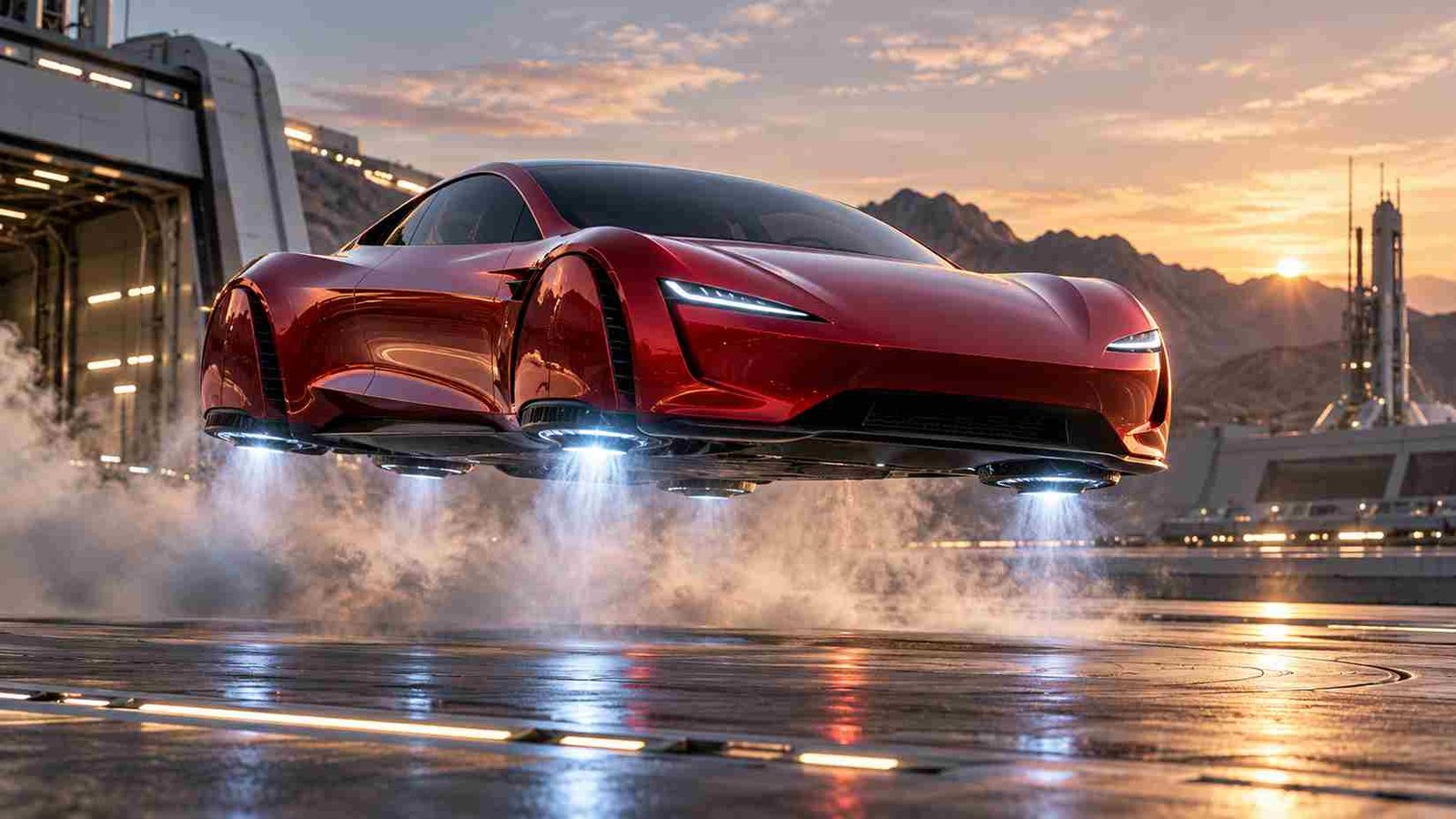
The two-seater drove onto a curved ramp and traveled upside down with help from a suction system. It then used built-in thrusters to turn while briefly airborne and settle back onto the ground. Another part of the demonstration showed it clearing other Tesla vehicles. According to the Reuters report on the Tesla Roadster 2026 reveal, the car was developed with technology from SpaceX, Elon Musk’s aerospace company.
These are striking demonstrations, but they happened in a prepared test environment. They do not establish that the car can make a sustained journey through the sky. That distinction matters whenever a headline calls it the world’s first flying car.
How Does Elon Musk’s Flying Car Technology Work?
The idea is not to bolt airplane wings onto a Tesla. The Roadster prototype combines ordinary electric-car propulsion with specialized systems borrowed from aerospace engineering. The feature getting the most attention is a set of cold-gas thrusters, which release stored, pressurized gas to generate a force in a chosen direction.
A useful way to think about this is that wheels move the car along the road, while short bursts of gas can help change the way it moves in a controlled demonstration. A separate suction system helps the vehicle stay attached to a surface when gravity alone would pull it away, as in the upside-down ramp sequence.
This is very different from the continuous lift an aircraft needs for meaningful flight. Staying in the air long enough to travel from one location to another requires sustained lift, energy, control, stability and many safety protections. Tesla has not demonstrated those everyday flying-car abilities in the footage released so far.
Is the Tesla Roadster Really a Flying Car?
It can become airborne, but that is not the same as being a practical flying car. The Roadster demo showed a controlled jump, a mid-air maneuver and a landing. That is a genuine technical achievement, yet it stops well short of showing an aircraft-like vehicle that can take off, remain aloft, navigate across a city and land somewhere else.
This is the detail I would want every viral video to explain. The word “flying” makes perfect sense as a dramatic description of the moment the Roadster leaves the ground. It becomes misleading when it suggests that Tesla has already solved the much larger problem of day-to-day airborne transportation.
A conventional flying-car concept or an electric vertical-takeoff aircraft has to be engineered around flight itself. The Roadster is still presented principally as a high-performance road-going sports car—albeit one with experimental aerospace-inspired capabilities.
Tesla Roadster 2026 Specifications: Claims vs. Confirmed Facts
Tesla executives discussed some dramatic performance targets at the unveiling. These figures are useful for understanding the ambition of the vehicle, but they should not be treated as independently certified specifications for a production car.
| What Tesla says | What readers should know |
| 0–60 mph: under 1 second | An event claim; not an independently verified production-car test. |
| Top speed: over 230 mph | An announced target, not a speed verified for customer deliveries. |
| Range: over 300 miles | Newer event figure, different from the older 620-mile claim still visible on some Tesla pages. |
| Two-seat redesigned prototype | The October reveal vehicle is a two-seater, unlike some older four-seat concept material. |
| Production: 2028 target | Tesla’s plan, not a guaranteed customer delivery date. |
One point worth checking carefully is the official website. The Tesla Roadster information page has shown specifications from the earlier concept, including 1.9 seconds to 60 mph and around 620 miles of range. Those historical marketing figures should not be blended with the newly announced 2026 figures as if they describe one finished production model.
Elon Musk Flying Car 2026 Price: What Will the Roadster Cost?
As of October 18, 2026, Tesla has not announced a final selling price for the newly redesigned Roadster. That is the clearest answer to the price question, even if search results and social media posts present confident dollar amounts.
For context, Tesla talked about a $200,000 starting price years ago for the older second-generation Roadster concept. The October 2026 unveiling did not confirm that this remains the price. Reuters also reported reservation deposits of $50,000 for a Performance version and $250,000 for a Thrust version. An invitation-only Rocket version was described separately.
Those deposit figures are easy to misunderstand. A reservation deposit is not the full purchase price. It is a payment associated with a potential future order, not proof that the car costs that exact amount or that delivery is guaranteed. Anyone writing about Tesla Roadster prices should make that separation obvious.
Tesla Flying Car Release Date: Is 2028 Realistic?
The company says it plans to begin production in 2028. That is the current target—not a date when customers have been promised a delivered car. It is particularly important to remember the Roadster’s long history: the earlier second-generation concept appeared in 2017, with an initial expectation of deliveries around 2020. That schedule slipped repeatedly.
Could production begin in 2028? Yes, it is possible. Do we know that it will? No. Moving a dramatic one-off demonstration into a vehicle that can be manufactured, supported, sold and legally used at scale is a very different task. For now, I would treat 2028 as a target to watch rather than a date to mark as certain on a calendar.
Can People Legally Drive or Fly the New Roadster?
This may be the least flashy question, but it is among the most important. Tesla has not established that airborne Roadster maneuvers will be approved for normal public roads. Road rules differ between places, and a vehicle moving upward or turning in the air raises issues far beyond the normal approval process for a fast sports car.
The Associated Press coverage of Roadster safety, regulation and reservations highlights these unresolved questions, along with the lack of a guaranteed delivery schedule. Tesla also said the October demonstration was operated autonomously for safety, rather than with a person performing the maneuvers.
Until the engineering, regulatory and consumer-safety questions are answered, it is better to view the airborne functions as experimental prototype capabilities, not features that ordinary drivers can expect to use in traffic.
Why I Think This Tesla Demonstration Still Matters
It would be easy to dismiss the reveal as just another internet spectacle. I do not think that is fair. Getting a full-size sports car to perform carefully controlled movements with thrusters and suction systems is an unusual engineering demonstration, and it shows why Tesla and SpaceX working together attracts attention.
At the same time, there is a difference between showing something impressive and delivering something useful. I am less interested in whether a car can briefly leap over another vehicle than in the questions that follow: Can the system work reliably? Can it be tested and certified? Can it be maintained? Can people actually buy the car when the manufacturer says they can?
Those questions do not make the Roadster less exciting. In my view, they make the story more interesting, because the real test begins after the stage lights go off.
Tesla Roadster vs. a True Flying Car
The Roadster and a purpose-built flying vehicle are trying to solve different problems. The Roadster starts with the priorities of a performance car: acceleration, control, looks and driving experience. A true flying vehicle must also stay airborne for useful distances, manage changes in weather and airspace, and meet rules designed for aviation.
So the Tesla flying car headlines make sense as shorthand for a visually extraordinary demo, but they do not mean Tesla has announced a replacement for airplanes or helicopters. The company has demonstrated short airborne movement, not a routine method of flying from one neighborhood to another.
What We Know—and What We Still Need to See
What is supported by the October 2026 reveal
- Tesla publicly demonstrated a redesigned, two-seat Roadster in Texas on October 15.
- The prototype used thrusters to maneuver briefly in the air and a suction system on an inverted ramp.
- Executives announced ambitious speed and acceleration figures and a production target of 2028.
What is not established yet
- A final retail price, dependable delivery date or publicly available production model.
- Permission for consumers to use the unusual airborne features on public roads.
- Sustained, practical point-to-point flight like an aircraft or everyday flying car.
Frequently Asked Questions
Did Elon Musk launch a flying car in October 2026?
Tesla unveiled an airborne-capable Roadster prototype on October 15. It was a public product demonstration, not the retail launch of a flying car that customers can take home.
Can the Tesla Roadster fly like an airplane?
Not based on what has been demonstrated. It can briefly leave the ground and maneuver with thrusters, but sustained flight was not shown.
How fast is the 2026 Tesla Roadster?
Tesla claims acceleration from 0 to 60 mph in under one second and a top speed exceeding 230 mph. These are announced performance figures, not verified results from a customer production model.
How much is the new Tesla flying car?
There is no confirmed final price. The reported $50,000 and $250,000 figures refer to reservation deposits for different versions, not the completed purchase price.
When will the Tesla Roadster be released?
Tesla currently says it aims to start production in 2028. The company has not guaranteed a customer delivery date.
Is the Roadster flying feature road-legal?
Public-road approval for the airborne functions has not been established. The demonstration took place in a controlled setting.
Is this the same Roadster Tesla showed in 2017?
It is the long-awaited second-generation Roadster project, but the 2026 reveal showed a redesigned two-seat prototype with different reported performance and range figures from the earlier concept.
Final Thoughts: Real Technology, Big Questions
The Elon Musk flying car 2026 story is neither a made-up viral clip nor proof that flying cars have finally become everyday transportation. Tesla showed a prototype doing things that would have sounded unlikely for a road car just a few years ago. That is worth talking about.
For me, the more useful headline is also the more accurate one: Tesla has demonstrated a rocket-assisted Roadster, but the price, 2028 production goal and real-world usability still need to be proven. If Tesla can turn the spectacle into a dependable product, the Roadster could become a fascinating chapter in electric-car history. Until then, it is best to enjoy the engineering—and keep the claims in perspective.
